I've identified a key management skill: Tactical Forgetting. There are some things a manager doesn't need to know, and if a team accidentally provides too much transparency, their manager can benefit from tactical forgetting.
Which leads me to a corollary observation: any sufficiently advanced management technique is indistinguishable from senility.
31 August 2013


20 August 2013
.jpg)
.jpg)
18 August 2013
Observationally, Are We Getting Dumber?
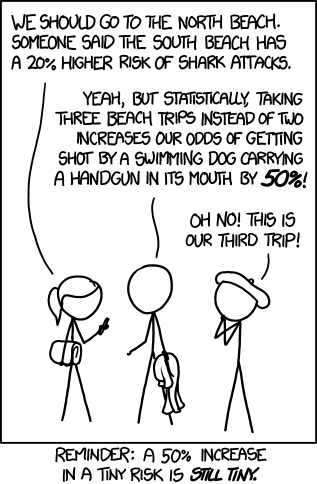 |
| http://xkcd.com/1252/ |
Two problems. XKCD perfectly describes one, which is that a relative risk increase is just about useless if you don't know the absolute risk. The other side of the problem: where do these risk values come from?
In 2001, Oxford Journals' International Journal of Epidemiology published "Epidemiology--is it time to call it a day?". Six years prior to that Science published "Epidemiology Faces Its Limits". So, 12-18 years later, have we gotten smarter about epidemiology?
Nope.
Maybe it's the amount of data or accessibility or ease of publishing or the disappearence of professional editing, but bad or trivial or meaningless stats and probabilities seem more common than ever. Our risk assessment skills seem just as bad as ever.
Two helpful guidelines for understanding any risk metric you see:
- assume it's not from a controlled trial (in other words, assume it's low quality)
- remember guidance from actual epidemiologists, from the 1995 article [emphasis mine, and keep in mind that, say, a "20% higher risk" is a relative risk of only 1.2]:
As a general rule of thumb," says Angell of the New England Journal, "we are looking for a relative risk of three or more [before accepting a paper for publication], particularly if it is biologically implausible or if it's a brand new finding." Robert Temple, director of drug evaluation at the Food and Drug Administration, puts it bluntly: "My basic rule is if the relative risk isn't at least three or four, forget it." But as John Bailar, an epidemiologist at McGill University and former statistical consultant for the NEJM, points out, there is no reliable way of identifying the dividing line. "If you see a 10-fold relative risk and it's replicated and it's a good study with biological backup, like we have with cigarettes and lung cancer, you can draw a strong inference," he says. "If it's a 1.5 relative risk, and it's only one study and even a very good one, you scratch your chin and say maybe.
11 August 2013
Sous Vide Chili, Shortribs, and Chicken Breasts

Next post will not be about cooking, I promise.
Beef Short Ribs, Again
After the highly successful 72 hr, 55C shortrib trial, I decided to go for a more traditional braise texture. I smoked a slab of shortribs for a couple hours until they were near or at 50C, then cut them into individual ribs, bagged each, and put them into the water bath at 62C. I tried the first after 24 hours. It was tender and very good. The rest I left in for 48 hours. Even better! Very much a traditional braise texture -- flaking nicely, tender, moist -- quite different than the tender steak-like texture of the 55C version. They were not falling off the bone, but easy to eat without knife and fork. Rib meat should require a bit of pull to get off the bone anyway. To serve: coated with bbq sauce and popped under the broiler until browned and crispy.

Chili
While I had the aquarium going, I made a few bags of chili. Old-school Texas style chili: no onions, no tomatoes, no beans. Just brisket, beef fat, dried chilies, and salt. I picked up five bags of whole dried chili peppers from borough market and came up with a method for turning them into a chili paste:
- stem, seed, and roughly chop the peppers
- steep them in hot water from a kettle for 15 minutes or so, then drain
- poach them in rendered beef fat over low heat for a while, then puree the whole thing


Chicken Breasts
Well this was easy. I cut up a couple chickens, smoked the legs and wings, saved the carcasses for stock, and bagged the boneless breasts for a first sous vide chicken trial. (Incidentally, the smoked wings made fantastic buffalo wings later: crisped them in a smoking hot pan with butter, then coated and sauteed in a mix of equal parts butter and frank's hot sauce.) The chicken breasts went into the aquarium for 2 1/2 hours at 60C and turned out just about perfectly. One of them I just browned skin-side in a hot pan with butter. The other I didn't even bother, just cut it up for another dish. It's odd in that it goes against expectations. I normally do a perfectly good job of cooking chicken no matter what method I use, but here I still expected the thin end to be overdone. It wasn't of course. It was just as perfectly tender and done as the thickest part. Brilliant.
Cooking Broccoli: High Heat, No Water
 |
| with chicken and cheddar |
I found this here: http://www.thewednesdaychef.com/the_wednesday_chef/2008/08/heston-blumenth.html
and it's my new favourite way to cook broccoli. Quick, easy, great results.
I use a cast iron frying pan. Basically:
v high heat, add some olive oil [smokin' hot]
broccoli in, lid on, don't touch it for 2 minutes
after two minutes: salt & pepper, some butter, shake it all about, lid back on, still high heat, don't touch it for 2 minutes
is it done? if not, leave it on another minute or two, otherwise it's ready to eat
Chocolate Ice Cream
Trying to get a suitably chocolatey ice cream is like doing titration quickly. You want to worry yourself that you've gone too far in order to hit the point that's just perfect. This is my modified version of "Ben's Chocolate" from the classic Ben & Jerry Ice Cream book from 1987 -- richer, less sugar, more choc (more egg, heavier cream, slightly different ratios, different instructions). I love it, but this will be too much for many people.
140g 90% dark chocolate [I use Lindt]
240g whole milk [I used a rich jersey & guernsey milk]
2 eggs + 1 add'l egg yolk
120g sugar
240g double cream
1t vanilla extract
pinch salt
method
chop chocolate and put in bowl
heat milk in microwave until almost boiling
pour hot milk over chocolate and let sit for a couple minutes
stir milk & chocolate together, should be smooth and melty now [if it is not smooth and melty, you should either panic or cry, or panic then cry, or threaten it with the microwave until it complies]
in separate bowl, which eggs&yolk
whisk in sugar
add dbl cream, vanilla, a hearty pinch of salt and whisk together to mix
mix chocolate into egg&cream mixture
chill before using
after chilling, whisk a bit before adding to ice cream maker
140g 90% dark chocolate [I use Lindt]
240g whole milk [I used a rich jersey & guernsey milk]
2 eggs + 1 add'l egg yolk
120g sugar
240g double cream
1t vanilla extract
pinch salt
method
chop chocolate and put in bowl
heat milk in microwave until almost boiling
pour hot milk over chocolate and let sit for a couple minutes
stir milk & chocolate together, should be smooth and melty now [if it is not smooth and melty, you should either panic or cry, or panic then cry, or threaten it with the microwave until it complies]
in separate bowl, which eggs&yolk
whisk in sugar
add dbl cream, vanilla, a hearty pinch of salt and whisk together to mix
mix chocolate into egg&cream mixture
chill before using
after chilling, whisk a bit before adding to ice cream maker
10 July 2013
Short Ribs Cooked For A Very Long Time
.jpg) | |||||||||
| Bought some beef short ribs from Elsco. 2 slabs. Both left on bone. Trimmed one. |
.jpg) |
| Then smoked the trimmed one. Smoked using mostly hickory and a little bit of oak. Lowest temp for the (hot) smoker, on an elevated rack to keep it even cooler and maximize the smoke. Left it in the smoker for 2 hours 20 minutes. Pulled it out when the hottest sub-surface temp was around 51C, and core temp was in the 40s. |
.jpg) |
| Double-bagged both the smoked and the unsmoked, untrimmed control slab of short ribs and cooked them at 55C for 72 hours. |
.jpg) |
| Finished with salt, pepper, butter, and a really hot cast iron pan. |
Got excessive with some short ribs and cooked them sous vide for 72 hours @ 55C, after smoking one set. Result: fantastic! Was not going for a typical braise texture (flakey, falling apart), but rather was aiming for very tender but still a bit steak-like. Was really excellent. The unsmoked version was like a super-tender roast beef. The smoked one, though, was just perfect. |
07 July 2013
Sous Vide Begins
or: "The Inevitability of the Middle Aged Modernist"
I got some new kit to play with. A relatively cheap vacuum packer to start. (The eventual upgrade will be a floorstanding chamber model.) It was only a matter of time before an immersion circulator found its way here.
First thing: steaks! Got some ribeyes from the Ginger Pig, salted each and added a bit of rendered beef fat for no good reason, plus peppered 2 of them. Cooked @ 56C for 6 hours. Finished with a sear in the cast iron pan with butter after dredging in cracked black pepper. Then deglazed the pan with the liquid from the cooking bags and reduced for sauce.
.jpg) Verdict: excellent! Great flavour as always but much more tender than normal for ribeyes. Big hit with all four of us. Definitely had the "edge to edge" consistency of doneness the method is praised for.
Verdict: excellent! Great flavour as always but much more tender than normal for ribeyes. Big hit with all four of us. Definitely had the "edge to edge" consistency of doneness the method is praised for.
Thoughts: definitely worthwhile. Would use again for tougher cuts of thick steaks to get that lovely tenderness. Might nudge the temp down a little. Probably would not use on fillet mignon, unless using for timing purposes. Also not likely to use for skirt steak/onglet as the finishing sear is not much shorter than how I would normally cook one entirely, but possibly worth an experiment to fiddle with texture.
Next up: eggs. Tried a few temperatures. The well-documented problem with eggs cooked to a precise temperature is that the most people prefer the whites cooked more than the yolk. There are something like 4 main proteins involved in turning an egg into different stages of cookedness and they denature at different temps. Cooking the yolk to an optimal consistency in a water bath will leave the white too soft for most people. Here's what I've discovered so far.
Poached eggs: cook at 62C for 45-60 minutes, then crack into water on low simmer. At this temp, they still crack like raw eggs. Whites are cohesive enough to keep a nice full shape around the yolk. Does not take long to firm them up while leaving the yolk as-is.
Egg for eating as-is: I like 65C. The yolk firms up but still has a rich, satiny texture. The whites are custardy but solid enough to be nice rather than off-putting. Obviously high-quality fresh eggs are a must.
.jpg) |
| New Immersion Circulator: Friend or Foe? Undecided. |
.jpg) |
| Vacuum packing things is really quite fun. Here's some broccoli. |
First thing: steaks! Got some ribeyes from the Ginger Pig, salted each and added a bit of rendered beef fat for no good reason, plus peppered 2 of them. Cooked @ 56C for 6 hours. Finished with a sear in the cast iron pan with butter after dredging in cracked black pepper. Then deglazed the pan with the liquid from the cooking bags and reduced for sauce.
.jpg)
.jpg) |
| 28l of 56C water and 4 ribeyes. |
.jpg) |
| This is a repurposed aquarium. Looks like it's almost fulfilling intended use here. |
Next up: eggs. Tried a few temperatures. The well-documented problem with eggs cooked to a precise temperature is that the most people prefer the whites cooked more than the yolk. There are something like 4 main proteins involved in turning an egg into different stages of cookedness and they denature at different temps. Cooking the yolk to an optimal consistency in a water bath will leave the white too soft for most people. Here's what I've discovered so far.
Poached eggs: cook at 62C for 45-60 minutes, then crack into water on low simmer. At this temp, they still crack like raw eggs. Whites are cohesive enough to keep a nice full shape around the yolk. Does not take long to firm them up while leaving the yolk as-is.
.jpg) |
| Poachy. |
.jpg) |
| And let's vacuum pack a slice of bread. |
13 June 2013
Brisket Day

Last Saturday: Brisket Day.
After 11 months and at least a dozen smoker sessions -- spare ribs, loin ribs, beef ribs, sausages, chicken, pork, turkey, goose, and plenty of duck, plus one chocolate cheesecake -- the time had come for brisket.
I got a genuine packer cut brisket from The East London Steak Company, delivered to me at 6am on a Friday morning. Over 6 kg -- a proper brisket that would be at home in the US. I trimmed off a good bit of fat, so pre-cooking weight was probably around 5.5 kg or so. The trimmed fat was later rendered, strained and saved.
So on Saturday:
05:49 Smoker on. Yes, a very early start. I'd wheeled the smoker out and had it all setup and ready to go the night before. It's about 80kg of metal, not a big back garden theft worry. Trimmed the cut as mentioned, right down to the surface to expose the lovely beef. No rub to speak of, just a generous amount of salt and a little bit of black pepper.
06:25 Brisket on. Temp at grate was about 88C. My plan was to start at relatively low temp then up it over a few hours to a max of around 110C (230F). The wood was a mix of oak and hickory (pellets, cookshack).
08:20 Upped heat. Two hours in, turned the heat up.
09:20 Temp check. Three hours in, temp at grate is about 100C, brisket internal temp about 40C. I upped the controller another 5C and topped up the hopper with some cheaper pellets -- Lil Devils, a blend consisting of, I think, mostly alder and some oak. These are about half the price of the cookshack pellets. After a few hours, not much smoke is getting into the meat anymore. The smoker I have generates all heat by burning pellets so spending the next
10:45 Temp check. Brisket about 51C internal after nearly 4 1/2 hours. Upped the controller another 5C to yield a cooking temp of around 110C. The slow ramp-up seems like a good tactic. Now waiting for the stall. This is the point at which the brisket gets to around 65C. Surface evaporation can keep it at the same temperature for hours, which can cause panic and heat up-turning. This is to be avoided. Either leave it in the smoke and wait it out, or crutch it. We're going to crutch it.
12:45 The stall. The brisket parked itself at 64.7 for a while. So 6 1/2 hours in, time for the crutch. We cut maybe 14th (by weight) off the end -- the thinnest third, the exposed part of the flat -- for two reasons: (1) we wanted to experiment with not crutching, and (b) the thing wouldn't fit into the pan without cutting that off. So with the thin part of the flat still in the smoker, the rest of it, big hunk of meat, went onto a rack in a deep pan, with water under the rack. The whole thing was closely and tightly covered with a few layers of foil then put into the oven, set at 110C.
16:55 Done! 10.5 hours of cooking, with crutch. Aiming for 95C internal. at 65C all the water abandons ship and you get a big piece of shoe-leather, but then the collagen melts and it becomes tender, moist, and delicious again. Ostensibly. We'll see. This was kept wrapped up and left in the oven, cooled down to warm/hold temp. At the same time the much smaller piece in the smoker was still not quite done, although it was past the stall and getting there -- 88C.
17:30 Done (pt 2). The flat remnant in the smoker now 95C. This was covered and put into the warm oven to rest, crammed in below the bigger piece. Now the smoker was upped to 150C to cook a whole mess of sausages and hot dogs.
18:30 Served! First sliced the all-smoker flat. Really nice smoke ring. Kind of dry. Good flavor, and not tough -- fairly tender, but still kind of dry. Then... the big piece. Oh, man. Unbelievable. Incredible flavor, meltingly tender and moist. Was almost hard to slice it was so tender. The whole of the big piece was great, but especially the point (the point!). Wow.
So yes, it was worth it. We declared victory. Brisket Day was a big success and there will be a brisket #2 in the smoker's future.
P.S. I'm having a hard time remembering what I served with it, aside from more meat. Oh yeah, a big pot of pinto beans. And some crisps. And some tomatoes, sliced or chopped or something. And a homemade thousand-island-ish dressing with loads of fresh horseradish I'd prepared while the brisket was smoking. Rolls and tortillas as well, maybe? I didn't want any wheat to get in the way of the meat, so gave that a miss.
P.P.S. There were almost no leftovers. I was expecting a lot. So much that I was going to slice and freeze the leftovers. There was enough for me later to chop it up, fry it in the rendered beef drippings with cracked black pepper and crushed red pepper (mit scharf!) until the edges were dark brown and crispy, then melted cheddar over the top and horseradish/thousand-island dressing and diced tomatoes underneath. Yes.
P.P.P.S. You'd think with an elapsed cooking/prep time of nearly 13 hours I would have had time to take more photos, but no. Next time?
12 June 2013
Pre-Brisket Meat Marshalling: East London Steak Co.
I love my local butcher, but I really liked the looks of ELSco. The perfect excuse for an order came when I picked a Brisket Day: the day I finally put a full brisket into the smoker. It's very difficult to get packer cut brisket from butchers here. Mostly you get rolled brisket. It's either a different cut or just the flat of the same cut, I can't quite tell which, but in either case, it's wrong.
But The East London Steak Co. offer a genuine packer-cut brisket. As I always say, anything worth doing is worth overdoing, so I also ordered some beef sausages, some mahoosive hot dogs, and a few big hunks of short ribs. Deliver was next morning around 6am.

The hot dogs were great. I grilled those on brisket day (anything worth doing, etc.) Not just "good for London" -- hot dogs here are mostly awful, the only passable ones I've found in a grocery store have been Gilbert's Kosher -- but good even for the US. And the brisket? More on that later.
But The East London Steak Co. offer a genuine packer-cut brisket. As I always say, anything worth doing is worth overdoing, so I also ordered some beef sausages, some mahoosive hot dogs, and a few big hunks of short ribs. Deliver was next morning around 6am.

The hot dogs were great. I grilled those on brisket day (anything worth doing, etc.) Not just "good for London" -- hot dogs here are mostly awful, the only passable ones I've found in a grocery store have been Gilbert's Kosher -- but good even for the US. And the brisket? More on that later.
 |
| beautifully marbled shortrib |
23 March 2013
Flat Tyre Inside The M25

After no luck phoning a couple taxi companies, had instant luck using Hailo. Not kidding: was less than five minutes after a couple clicks in the app. Family not only got to LHR in plenty of time, but the driver called me after dropping them off to let me know they'd made it and to make sure I was ok.
I was, because we have roadside assistance on our insurance. In only about 30 minutes, a cheerful and super-nice guy in a very cool flatbed truck appeared and loaded the aging A2 up and off we went, looking for a tyre shop. We bumbled about a bit before coming upon one in Uxbridge -- a small shop with no bay so the cars worked on sit outside, in the snow. The gent running it said he had a tyre that would fit so the driver unloaded the car and went on to the next stranded motorist.
It would be about an hour before I'd get a new tyre on the wheel, but the man running the shop and doing all the work could not have been nicer. The shop was unheated except for a tiny space heater behind the counter. He made coffee for me and for another guy sitting in the shop, and had me sit behind the counter by the heater (did I mention it was fucking freezing out in the intermittent snow?). The other guy... not sure what his deal was, he didn't seem like he worked there, nor like he was a customer, but he was clearly well known and was a bit of a character. I got the lowdown on a rather eventful trip he took to Brighton once.
Anyway, the incredibly sweet guy doing all the work would take breaks when he could no longer feel his fingers, but got me all sorted out. It cost about 1/3 of what I was expecting. So low I had to check twice that I hadn't misheard. When I was leaving, he asked me if I was from around there. Nope, east end, and I explained how I managed to find myself in his shop. "And you ended up here," he nodded, smiling and serenely satisfied, "it must be fate!" I don't know about that, but as I shook his hand I agreed in spirit -- an unexpectedly warm feeling from what should have been a miserably cold hassle.
16 March 2013
In Defense of The Rolled R Crowd
All the years I lived in Chicago I never once went to the top of the Sears tower. I went into the Sears tower, sure -- I was quite fond of Mrs. Levy's Deli -- just never up to the observation decks. But some things are touristy for a good reason. Just because something is popular doesn't mean it's bad. Life in London has made this obvious, repeatedly. Some places are worth going to even though other people also want to go there.
I finally went to see a show at the Globe two summers ago, Much Ado About Nothing. Yes, period costumes and all. Well, it was wonderful (Eve Best's Beatrice especially brilliant).
Neil Steinberg's recent column on a Goodman production of Measure for Measure praises Robert Falls while taking a bit of a swipe at this sort of thing in describing Falls' "lifelong rescue of Shakespeare from the rolled R crowd, returning it the alive thing it was meant to be".
I admit that there should be few theatre-going experiences that feel more contrived than attending a period production in a handbuilt elizabethan replica. Should have been, but wasn't.
It was cool and rainy, as it often is in London in summer. The actors were getting rained on. The yard was getting rained on. Some of the lines became unintentionally ironic, which didn't escape the notice of either the performers or the crowd. The groundlings got some well-deserved attention throughout. A favourite moment: Eve Best delivered a soliloquy kneeling at the edge of the stage, clutching the hand of a woman in the front row. The rain started coming down a bit more heavily. Without breaking character or missing a beat, she reached behind the woman's head and gently pulled her jacket hood up, smoothing it as a big sister would. It pulled the crowd in, enraptured. The whole play became a shared experience, both funnier and more intimate than I ever would have expected.
I like the escapism of theatre and genuinely prefer period versions of period pieces to modern retellings. Being in London in the rain in the Globe... I found the commonality of the experience across the hundreds of years not static and dead but reassuring and life-affirming. Talented actors performing good theatre is always an "alive thing".
I finally went to see a show at the Globe two summers ago, Much Ado About Nothing. Yes, period costumes and all. Well, it was wonderful (Eve Best's Beatrice especially brilliant).
Neil Steinberg's recent column on a Goodman production of Measure for Measure praises Robert Falls while taking a bit of a swipe at this sort of thing in describing Falls' "lifelong rescue of Shakespeare from the rolled R crowd, returning it the alive thing it was meant to be".
I admit that there should be few theatre-going experiences that feel more contrived than attending a period production in a handbuilt elizabethan replica. Should have been, but wasn't.
It was cool and rainy, as it often is in London in summer. The actors were getting rained on. The yard was getting rained on. Some of the lines became unintentionally ironic, which didn't escape the notice of either the performers or the crowd. The groundlings got some well-deserved attention throughout. A favourite moment: Eve Best delivered a soliloquy kneeling at the edge of the stage, clutching the hand of a woman in the front row. The rain started coming down a bit more heavily. Without breaking character or missing a beat, she reached behind the woman's head and gently pulled her jacket hood up, smoothing it as a big sister would. It pulled the crowd in, enraptured. The whole play became a shared experience, both funnier and more intimate than I ever would have expected.
I like the escapism of theatre and genuinely prefer period versions of period pieces to modern retellings. Being in London in the rain in the Globe... I found the commonality of the experience across the hundreds of years not static and dead but reassuring and life-affirming. Talented actors performing good theatre is always an "alive thing".
Subscribe to:
Posts (Atom)